

How People Immigrate Legally to the U.S.
The country’s legal immigration pathways often involve long wait times, complex procedures, and unpredictable politics
By Andrew Carnegie Foundation
Apr 7, 2025
Pathways to Legal Immigration
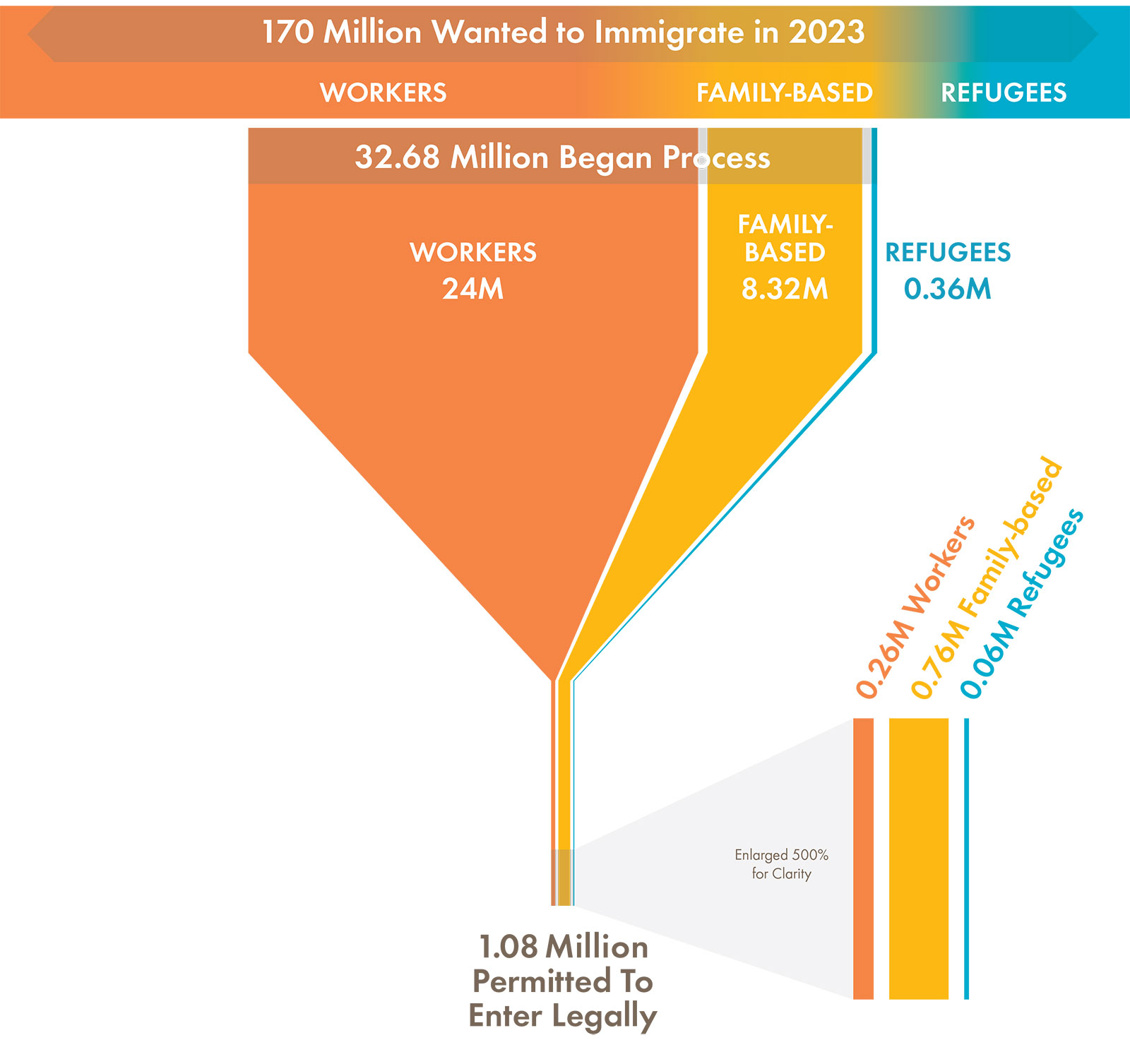
Nearly 35 million. That’s how many non-U.S. citizens had applications pending for green cards that would allow them to live and work legally and permanently in the United States as of 2024. But with the government capping the number of green cards it issues at a little more than one million per year, an overwhelming majority of applicants will have to wait years, if not decades, in a state of limbo. The wait for temporary, employment-based visas can be equally frustrating.
Immigration to the United States has become increasingly difficult. While Democrats and Republicans are deeply divided on immigration policy, immigration is one issue where Americans find agreement around the need for improvement. A December 2024 poll by the Associated Press–NORC Center for Public Affairs Research found that about half of U.S. adults say immigration should be a top focus for the U.S. government.
“Given how immigration is such an important part of our history and our competitive advantage as a society, fixing the problems with legal immigration should be a bipartisan priority,” said Doris Meissner, director of the U.S. Immigration Policy Program at the nonpartisan Migration Policy Institute, a Carnegie Corporation of New York grantee.
An August 2024 Pew survey found that nearly half of both Democrats and Republicans support maintaining current levels of legal immigration, and most Americans believe that highly skilled workers should be given priority over other immigrants.
“We have been able to build support for immigrants and immigration in places you wouldn’t expect to see,” said Jeremy Robbins, executive director of the American Immigration Council, a Carnegie Corporation of New York grantee. “That tells me there’s hope for progress.”
The following is a high-level summary of the available pathways to legal immigration, along with the challenges related to each.
Family-Based Immigration
The most common way to immigrate legally is through a family relationship. In 2023 people in the family-based categories made up 64 percent of the immigrants who were granted green cards.
This is by design: the Immigration and Nationality Act of 1965, signed into law by President Lyndon B. Johnson, created an immigration system that preferences immigrants with family relationships to Americans. While there is no limit on the number of green cards that may be issued for “immediate family members” — spouses, minor children, or parents — other family members of U.S. citizens, such as adult children and siblings, may apply for “family preference” visas, which have strict limits.
Challenges: As of late 2023, there were nearly four million people waiting overseas for family preference visas to become available. Due to limited staffing and processing capacity, the United States has at times failed to reach its annual limits on these types of visas, leaving hundreds of thousands of green cards “unused” in the family-based categories.
Adding to the problems is that the Immigration and Nationality Act places limits on family preference and employment visas so that no more than 7 percent of these visas can go to people from any single country each year. These limits do not reflect current immigration demand. As a result, individuals from countries with large numbers of applicants (such as Mexico, India, and China) face long waits.
“The 1965 law quickly proved itself to be out of step with what was really happening with the economy and immigration flows,” said Meissner.
Employment-Based Visas
The second-most common pathway for legal immigration is through work, with an employer generally having to petition for an immigrant to come and fill a specific job role.
Employment-based green cards are divided into five “preference” categories, with the priority given to workers with “extraordinary ability,” followed by professionals with advanced degrees, other workers, special cases, and finally immigrant investors, who may qualify for residency by making a significant investment in a U.S. business that creates new jobs.
The United States also admits a limited number of people through temporary work visas. There’s strong demand for the H-1B visa for highly skilled workers, which many immigrant workers have come to rely on while they wait for an immigrant visa to become available.
Challenges: The approval process for both permanent and temporary employment-based visas can be long, complex, and costly, often leaving applicants and employers waiting for years, and discouraging others from going through the process.
Even after a 1990 law increased the cap on employment-based green cards from 54,000 to 140,000, demand for such green cards has surged, resulting in extensive delays. Because employment-based green cards are also subject to per-country caps, the wait can be extremely lengthy for individuals from countries with large numbers of applicants.
Similarly, caps on temporary work visas keep tens of thousands of applicants in limbo overseas while contributing to hiring challenges throughout the U.S. economy. In April 2024, U.S. Citizenship and Immigration Services said it had received 470,000 eligible registrations for its annual lottery for H-1B visas; by law, it may approve only 85,000 per year.
“We are hurting ourselves by denying opportunities to people who want to come here and contribute to the U.S. economy as workers and entrepreneurs,” said Stuart Anderson, executive director of the National Foundation for American Policy (NFAP), a Carnegie grantee and nonpartisan research organization that focuses primarily on immigration.
Diversity Visas
Often called the “green card lottery,” the U.S. State Department makes 55,000 “diversity visas” available each year for individuals from countries with low rates of immigration to the United States. The program was created by Congress in 1990 to diversify the U.S. immigrant population.
Challenges: The diversity visa program is highly competitive; in 2023 more than 9.5 million people applied for the program’s 55,000 lottery spots.
In the final year of his first term, President Trump suspended the awarding of these visas; the action was overruled by a court decision that forced the administration to reinstate the program.
Refugees and Asylum
Both refugees and asylum seekers may be fleeing persecution in their home countries, but there are some important differences between them. In general:
- Refugees apply for refugee status from outside of the United States, and are admitted into the country if they are approved. Under U.S. law, the president sets a cap on annual refugee admissions at the start of each fiscal year.
- Asylum seekers are individuals already present in the United States who apply for protection from within the country. There is no cap on the number of asylees who may be approved each year.
Refugees and asylum seekers, if admitted, may apply for green cards and eventually citizenship.
Challenges: The world faces a migration crisis as growing numbers of people are displaced from their homes. In 2024 the United Nations counted 43.7 million refugees and 8 million asylum seekers worldwide.
The United States has welcomed more than 3 million refugees from other countries since 1975, and typically grants asylum to thousands of applicants a year. However, experts say the system for processing and resettling refugees and asylum seekers remains underfunded, overburdened, and hindered by political divides.
During the last year of the Biden administration, the cap on refugee admissions to the U.S. was set at 125,000 per year, up from a record low of 15,000 during the first Trump administration. In the opening days of his second administration, President Trump suspended all refugee resettlement in the United States; he also effectively suspended asylum indefinitely. As of March 2025, both measures face challenges in the courts.
Humanitarian Relief
Additional humanitarian relief measures allow certain people to enter and/or remain in the country temporarily.
These programs include “humanitarian parole,” granted case-by-case to people with an urgent need to enter the country (for example, to address a medical emergency), and Temporary Protected Status (TPS), granted to people from designated countries that are confronting armed conflict and other crises.
Generally, humanitarian relief programs don’t offer recipients a direct path to citizenship — but recipients may apply for a green card if they qualify through other means, like family or work.
Challenges: Humanitarian relief programs can suddenly change with a new presidential administration. For example, on the first day of his second term, President Trump terminated humanitarian parole programs that the Biden administration had adopted for immigrants fleeing turmoil in Cuba, Haiti, Nicaragua, and Venezuela. As of March 2025, the Trump administration has rescinded the TPS designations for Venezuela and Haiti.
Additional Resources
- How the United States Immigration System Works: A fact sheet from the American Immigration Council provides a summary with statistics on the U.S. immigration system.
- Why Legal Immigration Is Nearly Impossible: A detailed analysis by the Cato Institute shows how the U.S. immigration system “has made becoming an American a nearly impossible challenge.
- The Green Card Game: Could you navigate the U.S. legal immigration system? Play the game by Cato Institute, a Carnegie grantee.